BtrFS is the newest filesystem for Linux. Its is likely to replace ext4 at some point of time. Ubuntu 10.10 will include this in October this year.
Here is what is interesting about it.
- Compression on the fly. If you remember Stacker days when you could double your disk space without buying a new disk, you would know what I am talking about. BtrFS now brings on the fly compression to Linux file system.
- Easy resizing: Today if you want to resize your partition, you have to take a backup, shutdown, use gparted and cross your fingers/prey everything works well. With BtrFS, you will be able to resize any time even when you are using the file system.
- Snapshot backups, you can take snapshots of an existing file system when can be restored any time to go back to the same state.
- Checksum support for protection against crashes.
- Better performance, specially on SSD drives.
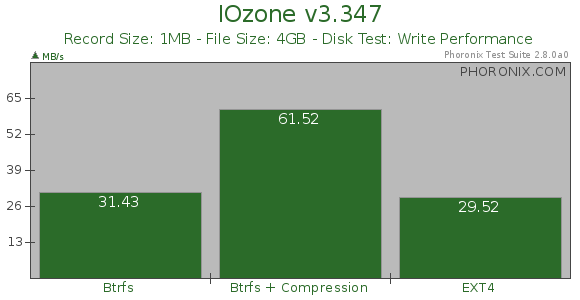
Phoronix has done a stress test by comparing Btrfs with ext4 with on this and published the results. Btrfs with compression gave best results in most tests.
Does it use journalling? At present I use ext2, with no swap, for my SSD. Would I use Btrfs the same way?
No doubt that btrfs is the way to go. However, I am not sure I will follow Canonical move in October for one reason:
I use image cloning software (Clonezilla Live) to weekly backup my files. Up to now, partclone and fsarchiver do NOT support btrfs.
Even if I know that btrfs allows easy snampshots, I do not feel confident enought to let my old safety tools go. SO, I’ll probably wait next Ubuntu version.
Maybe, btrfs will finally allow later the coming of age of incremental software on Linux platforms if somebody manages to wrap up this snapshot capacity in an easy way.